


Amethyst is purple quartz: ordinary silicon dioxide that traces of iron and natural irradiation inside the earth turned violet. It is the February birthstone and, in practice, the stone of intuition, the clear head and the crown. It is also one of the stones I have reached for most since I started making jewelry, so here is what it is, what it is worn for, where its name comes from, and the one thing you must never do with it.
What amethyst actually is
Quartz is one of the most common minerals there is: silicon dioxide, hard enough to rank 7 on the Mohs scale and stable enough to wear every day for a lifetime. Amethyst is that same crystal with a small amount of iron caught in its structure. On its own the iron does little. Natural irradiation from the surrounding rock, over geological time, changes how that iron sits in the crystal, and the stone goes purple. Pale lilac to deep violet, depending on how much iron and how much time.
Because it is quartz, amethyst washes like quartz, wears like quartz, and scratches softer stones like quartz. The purple is the only difference, and the purple is the whole point.
It is also the modern birthstone for February, which makes it one of the easier birthdays to get right. If someone you love was born in the dead of winter, a purple stone that stands for clear sight and a steady head is a good thing to put on their hand. It is a stone that does not care about birthdays, though. Most of the people wearing our amethyst were born in other months and chose it anyway, for the color or for the crown.
The name: not drunk
Amethystos is Greek for "not intoxicated." The ancients believed the stone kept a drinker sober, and they carved drinking cups from it and wore it to feasts on that theory. Pliny recorded the belief in his natural history and sounded unconvinced. Whether or not it ever saved anyone from a bad morning, the idea underneath has stayed with the stone for two thousand years: amethyst is for keeping your head. Clarity when everyone around you has lost theirs.
That is part of why it sat in bishops' rings for centuries, and why purple, the rare and costly dye of kings, made amethyst a royal stone long before anyone talked about chakras.
Intuition and the crown
In the modern practice of the chakras, violet belongs to the crown, the point at the top of the head where the everyday mind meets the one that dreams and knows things it cannot explain. Amethyst, being violet, became the crown's stone. We reach for it when the question is not "what should I do" but "what do I already know."
Traditionally it is worn for intuition, for meditation, for dreams, and for the kind of steadiness that comes from seeing clearly rather than from not feeling. It is the stone of the night mind. In the studio we set it where the seeing happens: at the full moon on the triple moon, and on the hand of the goddess who holds the torch at the crossroads.
Why we build with it
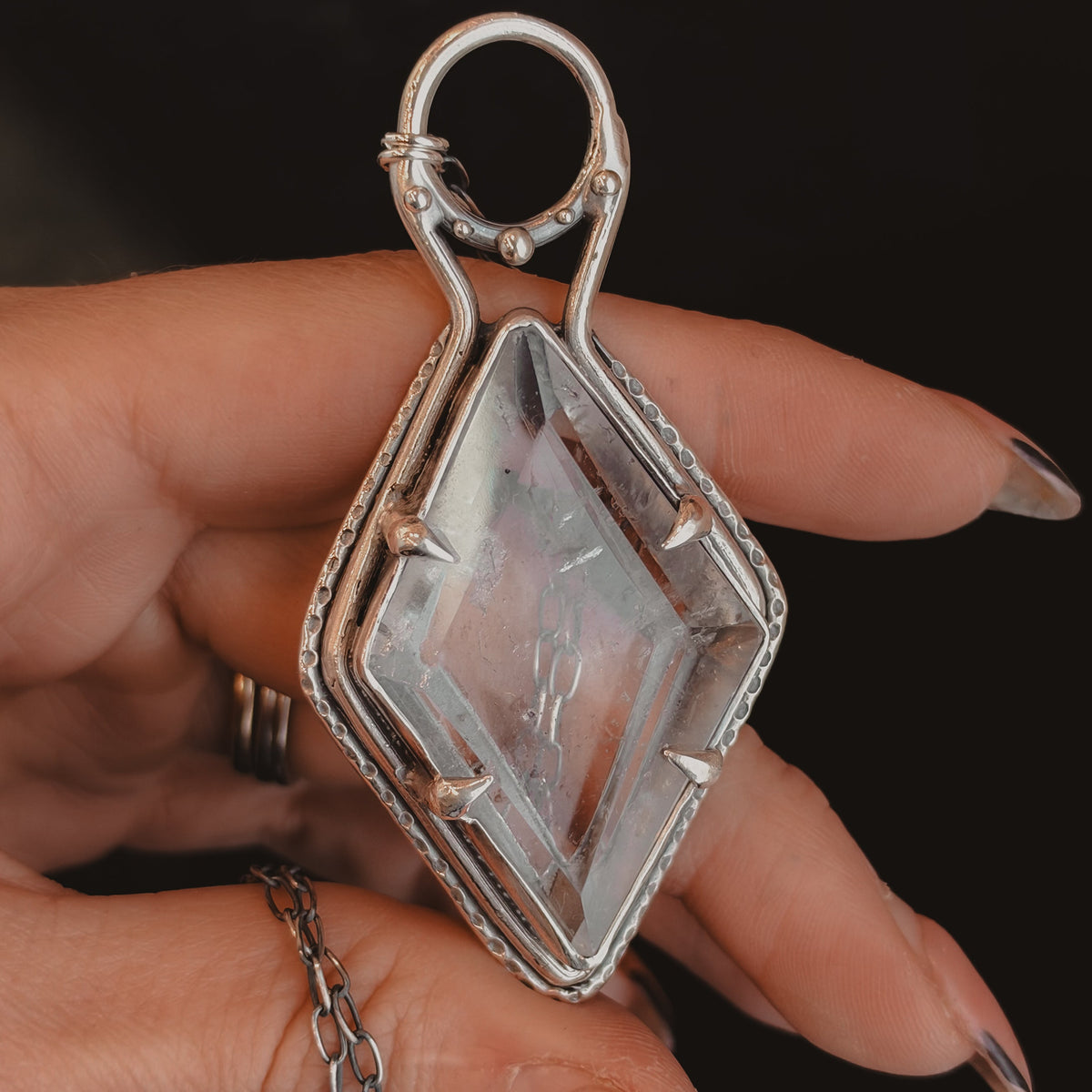
Every piece in this studio starts with a stone, and amethyst has been on the bench since the beginning. I love it for a practical reason and a stubborn one. The practical reason: it is quartz, so it is tough, it takes a polish, it cuts into cabochons and points and facets equally well, and deep violet against oxidized sterling silver is one of the best color pairings I know. The stubborn reason: it is the goddess stone. When I designed the Hecate Ring, the goddess of the liminal needed a stone for seeing in the dark, and a deep violet amethyst cabochon was the only answer. When the Triple Moon Goddess Necklace needed a stone at the full moon, the moment of seeing clearly, it got amethyst. Our hex-shaped talisman for new beginnings carries it too, in sterling silver or brass, and when a one-of-a-kind amethyst point comes through the studio it usually ends up on a ring, because a point wants to be worn where you can look at it.
Browse everything we set with it in the amethyst collection. Where the triple moon itself comes from is in our guide to the symbol.
The one rule: keep it out of the sun
Amethyst fades. Long exposure to direct sunlight slowly bleaches the violet toward pale, and the color does not come back. So do not charge amethyst on a sunny windowsill, do not leave it on the dash of a car, and do not store it where the afternoon light lands. Charge it in moonlight instead, which is where it belongs anyway. Heat does something stranger: a hot enough kiln turns amethyst yellow, and a great deal of the citrine sold in the world began life as amethyst that someone baked.
Wearing it is easy. Warm water, mild soap, a soft cloth, dry it fully. Take it off before swimming, mostly for the metal's sake. Store it in its own pouch so it does not scratch your moonstone. The full routine is in our stone-by-stone cleaning guide.
Questions we get about amethyst
What does an amethyst ring mean? Traditionally, a clear head and clear sight: intuition, the crown, and the old Greek promise of staying sober when everyone else is not. On the hand it is worn as a reminder to trust what you already know. Ours sit in goddess rings and shields for exactly that reason.
What month is amethyst the birthstone for? February, on the modern list. If you were born in the coldest month, your stone is the color of the sky just after sunset, and it has been February's since the lists were written.
Can amethyst go in the sun? Briefly, yes. For hours and days, no. Long exposure to direct sunlight fades the purple, and the color does not return. Cleanse and charge it in moonlight, and store it out of direct light.
Amethyst is the stone for the part of you that already knows. Wear it where you will see it when you forget.
From the studio
Amethyst has sat on this bench since the beginning; these are the pieces it lives in now.

- Hecate Ring: a deep violet amethyst cabochon in sterling silver, named for the goddess of thresholds
- Triple Moon Goddess Necklace: the three moon phases in sterling silver, amethyst at the full moon
- Maiden Hex Necklace: amethyst in a sterling silver hex, her talisman for new beginnings
- The Priestess Ring: a one-of-a-kind amethyst point in sterling silver, size 8

