


Hecate is the Greek goddess of the crossroads, the threshold and the torch-lit dark: the one you meet where three roads come together, with her dogs, her keys and a flame in each hand. She is the goddess I named a ring after, and with her modern feast night falling on November 16, she is our Goddess of the Month. Here is who she was to the Greeks, what her symbols mean, the stones paired with her in practice, and why the Hecate Ring looks the way it does.
Who Hecate was
She is older than most of the stories told about her. In Hesiod's Theogony, one of the oldest Greek poems we have, Zeus honors Hecate above all others and gives her a share of the earth, the sea and the starry sky, which is a remarkable thing to say about a goddess who was never one of the twelve Olympians. She is the daughter of Perses and of Asteria, the goddess of falling stars, and she keeps her powers after the old gods fall.
In the Homeric Hymn to Demeter, Hecate is the one who hears Persephone cry out when she is taken, and who carries torches to help Demeter search. When Persephone returns from the underworld, Hecate becomes her companion, walking before and behind her between the worlds. That is the role she keeps for the rest of antiquity: the guide at the boundary, the one who can go down and come back.
Later, especially in the Roman world and in the magical texts, she grew darker and larger: goddess of the night, of ghosts and of witchcraft, called on at the crossroads by the dark of the moon. Both versions are real. She was honored at Athenian doorways and feared on the roads at night, often by the same people.
Her symbols
The crossroads. Specifically the three-way crossroads, the place where a road forks and you have to decide. The Greeks set small shrines to her there and at the doors of their houses; the Romans called her Trivia, "of the three ways." She is the goddess of the moment before the choice.
The torches. Usually two, one in each hand. Light carried into the dark, not light that banishes it. Hecate does not turn the lights on. She walks in with you.
The keys. One of her titles was Kleidouchos, the key-bearer. She holds the keys to the thresholds: the gates of the underworld, the door of the house, the line between one state and the next.
The dogs. Dogs were sacred to her, and in the old stories dogs barking in the night meant she was near. They are guardians and guides, the animals who know the way home in the dark.
The triple form. From the fifth century BCE, Hecate was sculpted as three figures standing back to back, facing all three roads at once. The Greek word is Trimorphis, three-formed. The reading of those three faces as maiden, mother and crone is a twentieth-century layer; to the Greeks she was almost always shown as a young woman. The crone Hecate is ours, not theirs, and that is fine as long as we say so.
Her night: November 16
The Night of Hecate on November 16 is a modern observance, kept in contemporary pagan and witchcraft practice rather than inherited from an ancient calendar. The ancient practice was monthly. On the dark of the moon, Athenian households left offerings for her at the crossroads, the supper of Hecate, and the old instruction was to leave it and walk away without looking back. If you want to keep her night, that is the template. Go to a crossroads, or to your own front door, after dark. Leave something small: bread, an egg, a spoonful of honey, part of your own meal. Say out loud which threshold you are standing at. Then go, and do not look back.
Her stones, as practice
The pairings here are modern practice, not ancient record; the Greeks gave her suppers, not crystals. In the studio we reach for four.
- Black onyx for the dark of the moon and the crossroads at night: banded chalcedony, worn for grounding and for boundaries, for holding your place while you decide.
- Labradorite for the torch in the dark: a feldspar whose gray surface flashes blue and gold when it moves, worn for transformation and for seeing what is hidden.
- Amethyst for the threshold itself: quartz colored purple by iron and natural irradiation, worn for intuition and the crown. It is the stone we chose for her ring.
- Smoky quartz for the walk home: clear quartz darkened by natural irradiation, worn for grounding and for letting go.
The Hecate Ring, from the bench
I named a ring after her because she is the goddess of a moment I kept seeing in the women who write to us: standing at the fork, not yet moving, not afraid. The Hecate Ring is part of our Astral collection, and it carries a deep violet amethyst cabochon in sterling silver. I chose amethyst because it is the stone of the threshold between the everyday mind and the one that dreams, and I chose a cabochon, smooth and domed, because it reads like a single steady flame rather than a flashing one. The ring is built the way everything here is: carved in wax, lost wax cast, hand set, oxidized so the recesses go dark and the high points stay bright, in a two-metalsmith studio with no production line.
Her mother in Hesiod is Asteria, the goddess of falling stars, and the Asteria Necklace lives in the same Astral collection. I did not plan that. It is exactly the kind of thing Hecate would arrange. Browse the amethyst collection for the rest of her stone, and read the last entry in this series, Goddess of the Month: The Morrigan, for the one who came before her.
Questions we get about Hecate
What is Hecate the goddess of? Crossroads, thresholds, the night, and the boundary between the living and the dead. In the oldest Greek source she is also honored with a share of earth, sea and sky; the witchcraft and ghost associations grew stronger in the Roman period and after. She guides rather than rules: the torch, not the throne.
What are Hecate's symbols? Two torches, keys, dogs, the three-way crossroads, and the triple form, three figures standing back to back. Later tradition adds the dark moon and the serpent. If you want to wear her, any one of those is enough; many of our customers choose the stone and let the goddess stay private.
What stone is associated with Hecate? No stone is named for her in the ancient sources. In modern practice, black onyx, labradorite, amethyst and smoky quartz are the four most often paired with her: the dark moon, the torch, the threshold and the way home. We set her ring in amethyst.
She does not tell you which road. She holds the light so you can see that there are three.
From the studio
Her ring, her mother's necklace, and two more pieces for the dark of the moon.

- Hecate Ring: a deep violet amethyst cabochon in sterling silver, from the Astral collection
- Asteria Necklace: the goddess of falling stars, a rose cut emerald in sterling silver
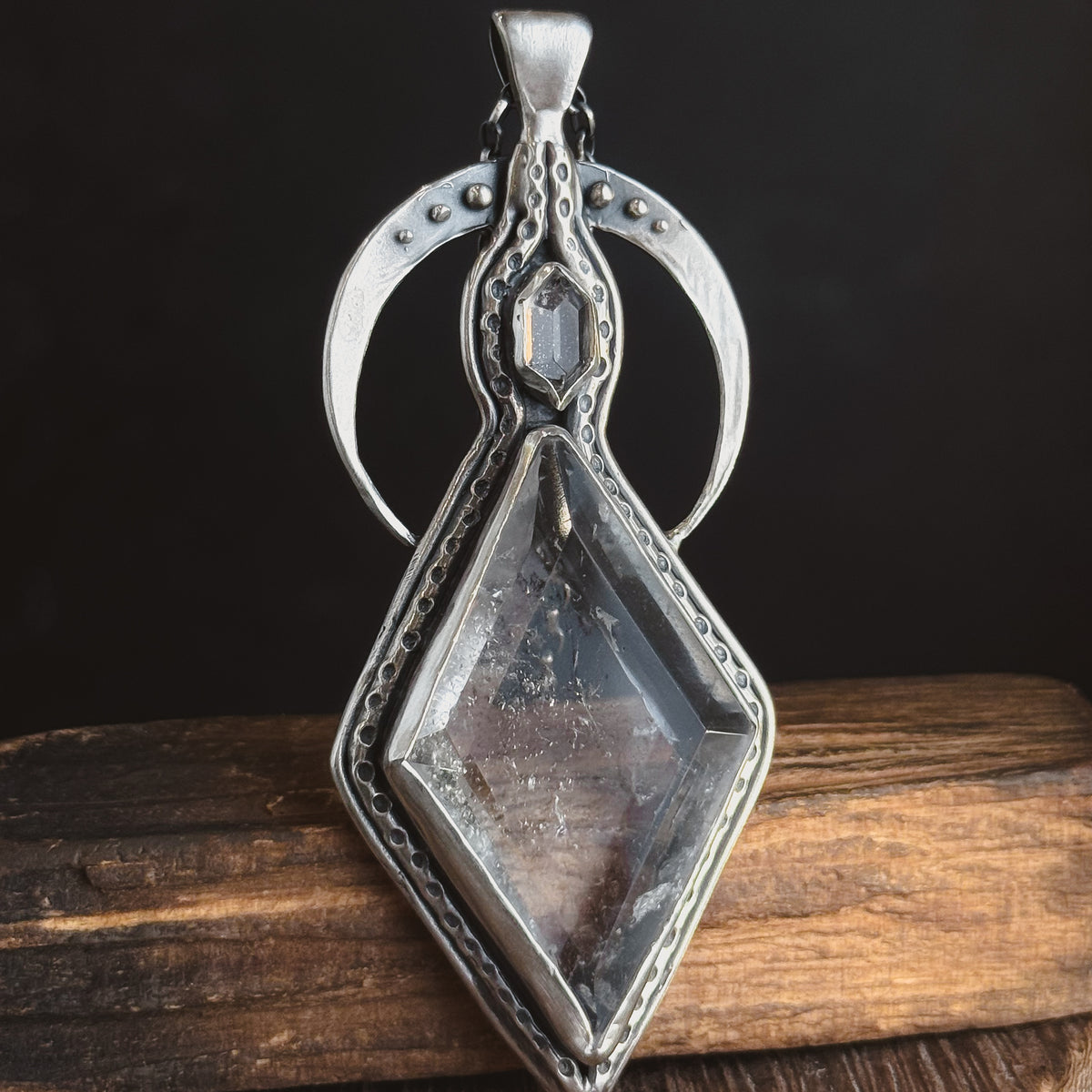
- Triple Moon Goddess Necklace: the three moon phases in sterling silver with a natural amethyst
- Moon Phase Shield Ring: smooth black onyx inside the full lunar cycle, sterling silver

