

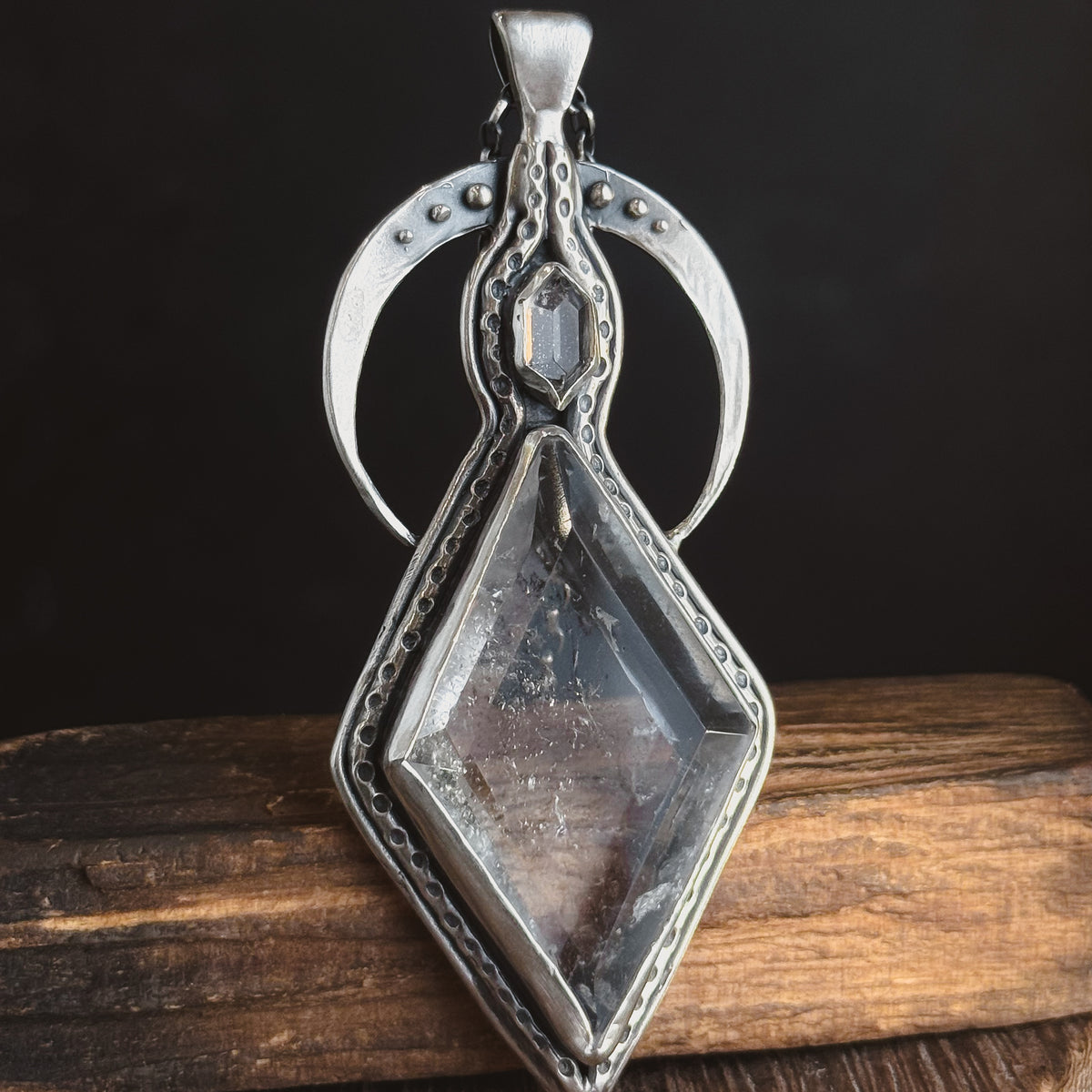
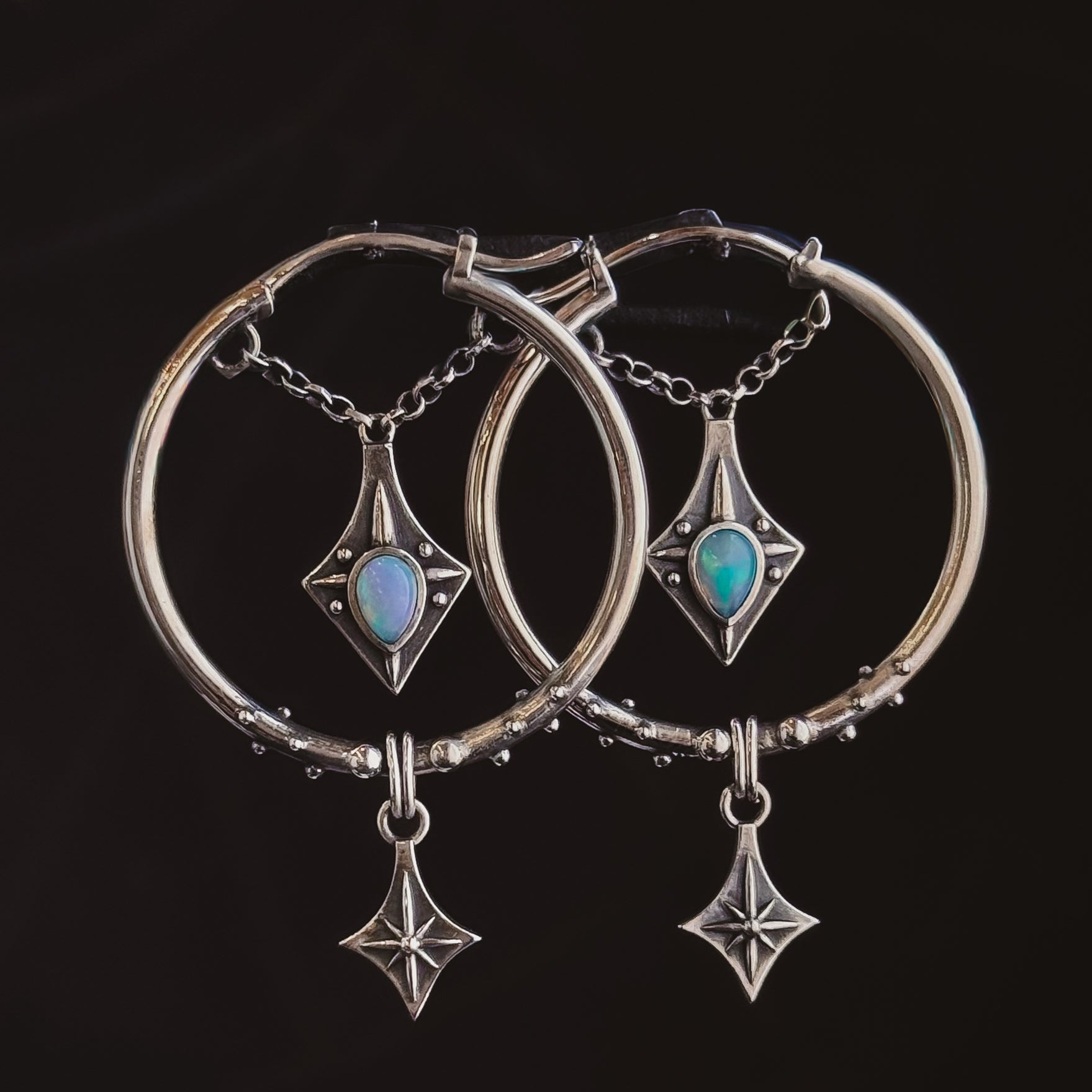

Shadow work is the practice of turning toward the parts of yourself you learned to hide: the anger, the envy, the need, the grief you decided long ago was not allowed. Stones do not do that work for you, but the right one in your hand gives it somewhere to land, and the dark half of the year, from Samhain to spring, is when we do most of ours. Here is what shadow work means, a fifteen-minute practice you can actually keep, and the three stones we hold while we do it.
What shadow work is (without the jargon)
The word comes from Carl Jung, who used "the shadow" for the side of the personality a person does not identify with: everything we were taught to push down to be acceptable, and a few things we would rather not know we are capable of. His point was not that the shadow is evil. It is that whatever you refuse to look at does not go away. It runs you from behind. Shadow work is just the decision to turn around.
In practice it looks less like a breakthrough and more like a habit. You notice a reaction that is bigger than the moment deserves. You ask what it is protecting. You write down the honest answer instead of the flattering one. Over a season, those notes turn into a map of yourself you did not have before. It is slow, it is unglamorous, and it works.
Why the dark half of the year
Samhain on October 31 was the old turning of the year, the night the veil was said to be thinnest, and the start of the half of the year that belongs to the dark. The light goes, the garden dies back, and everything around us gets loud and bright as fast as it can. We go the other way. We wrote about Samhain, shadow work and the pieces we wear for it before, and the practice has not changed: this is the season to sit with what the rest of the year makes easy to avoid.
Three stones for shadow work
Black onyx: the one that holds the ground
Black onyx is banded chalcedony, a quartz grown in crystals too small to see, which is why it is dense and smooth instead of glassy. Most commercial black onyx is dyed to even out the color, which is standard and does not change how hard the stone is. Onyx is the stone we reach for first in shadow work because it is worn for boundaries and for grounding. In the traditions we work from, it absorbs and grounds what is heavy so it does not stay with you. It does not make the hard thing go away. It keeps you standing while you look at it. The Moon Phase Shield Ring sets a smooth black onyx inside the whole lunar cycle, dark phase included, which is the entire point of this season in one ring.
Smoky quartz: the one for letting go slowly
Smoky quartz is clear quartz darkened by natural irradiation inside the earth, which is still exactly as metal as it sounds. It is the gentlest of the dark stones, worn for grounding and for release, and it is the one I hand to people who find onyx too heavy for every day. In shadow work it is the second step: once you have seen the thing, this is the stone for setting it down a little at a time. The Draco Ring carries a smoky quartz in sterling silver, named for the dragon constellation, and it is a quiet ring for a quiet kind of work.
Labradorite: the one that shows you the flash
Labradorite is a plagioclase feldspar, and what looks like a gray stone throws blue and gold from inside when the light hits it at the right angle. That flash, labradorescence, comes from light scattering between the stone's internal layers. I cannot think of a better picture of the shadow: what looks dull and closed has color in it that only shows when you move. Labradorite is worn for transformation and intuition, and in shadow work it is the stone for the moment after, when you see what the hidden thing was for. It was usually trying to protect you.
A fifteen-minute practice
You need paper, a pen, one stone, and a door you can close.
- Two minutes: arrive. Sit. Put the stone in your non-dominant hand. Breathe until you are bored; boredom means the surface has settled.
- Three minutes: find the charge. Find one moment from the last few days when your reaction was bigger than the moment: a flash of anger, a sting of envy, a shutdown. Do not pick the worst one. Pick the clearest one.
- Five minutes: write without editing. Start with "What I did not want anyone to see was" and keep the pen moving. If you hit a sentence that makes you want to stop, that is the sentence. Stay with it one more line.
- Three minutes: ask what it protects. Every shadow is guarding something: a need, a fear, an old rule. Write what this one is guarding. Say thank you to it, out loud if you can stand to. It has been working hard.
- Two minutes: close. Put the paper somewhere it will not be read, or burn it safely in a bowl. Put your ring or your pendant back on. That is the signal to yourself that the session is over and the day can resume.
Do it once a week through the dark half of the year. Daily turns it into picking at a scab; weekly builds the map.
In the studio
Every collection here starts with an archetype or a question, and the dark ones have given us our best work: the Morrigan, Lilith, Persephone. I design with the shadow in mind because that is what my customers tell me they wear these pieces for. Not to look powerful, but to remember that they are, on the days it is hard to. "Remember my strength" is the phrase I hear most. A piece built as armor is also a piece that gives you permission to set the armor down for fifteen minutes and look. Browse the onyx collection for the rings that hold the ground while you do.
Questions we get about shadow work and stones
What crystals are best for shadow work? Black onyx, smoky quartz and labradorite are the three we hold, in that order: onyx for grounding and boundaries, smoky quartz for release, labradorite for seeing what was hidden. One stone is enough. Clear quartz works if you want a stone with no color at all, so your own intention is the only thing in it.
Do I need to cleanse my stones after shadow work? We do, after any heavy session. Moonlight, smoke, sound or breath all work, and the new moon is the night we do it as a studio. If a piece has sat through something hard with you, cleanse it before you wear it again.
Is shadow work safe to do alone? A fifteen-minute weekly practice with a pen and a stone is self-reflection, and most people are fine on their own. If what comes up is bigger than a notebook can hold (old trauma, grief that will not move, thoughts that frighten you), that is the point to bring in a therapist or counselor. Stones are company for the work, not a replacement for a person.
The dark half of the year is not a problem to fix. It is a room with the lights off, and you already know where everything is.
From the studio
The three stones from this post, in the forms we actually wear them.

- Moon Phase Shield Ring: smooth black onyx inside the full lunar cycle, sterling silver
- Draco Ring: smoky quartz in sterling silver, named for the dragon constellation
- Moon Maiden Necklace: labradorite in sterling silver, a talisman for awakening
- Moon Phase Shield Ring: the same shield ring, black onyx cast in brass

