

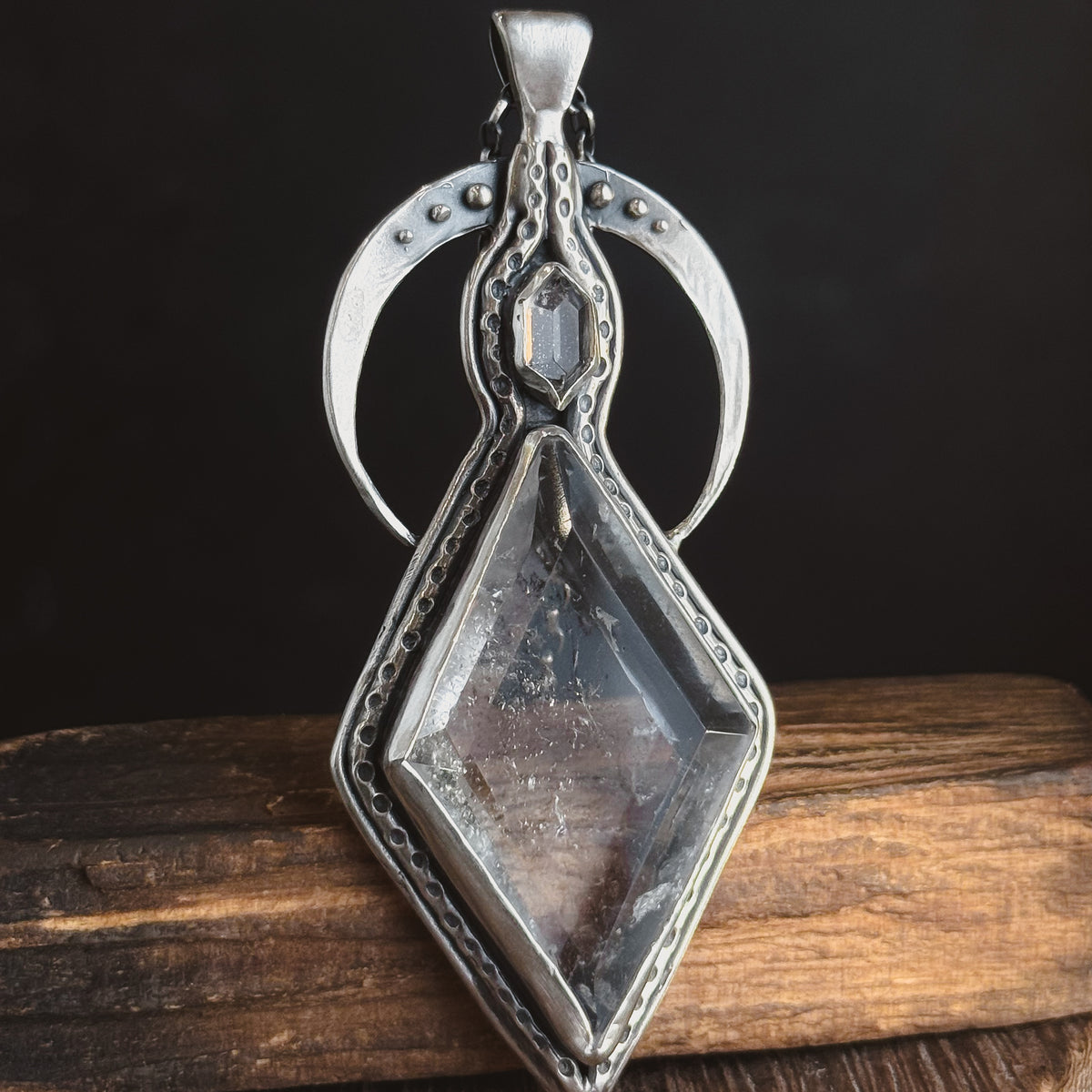
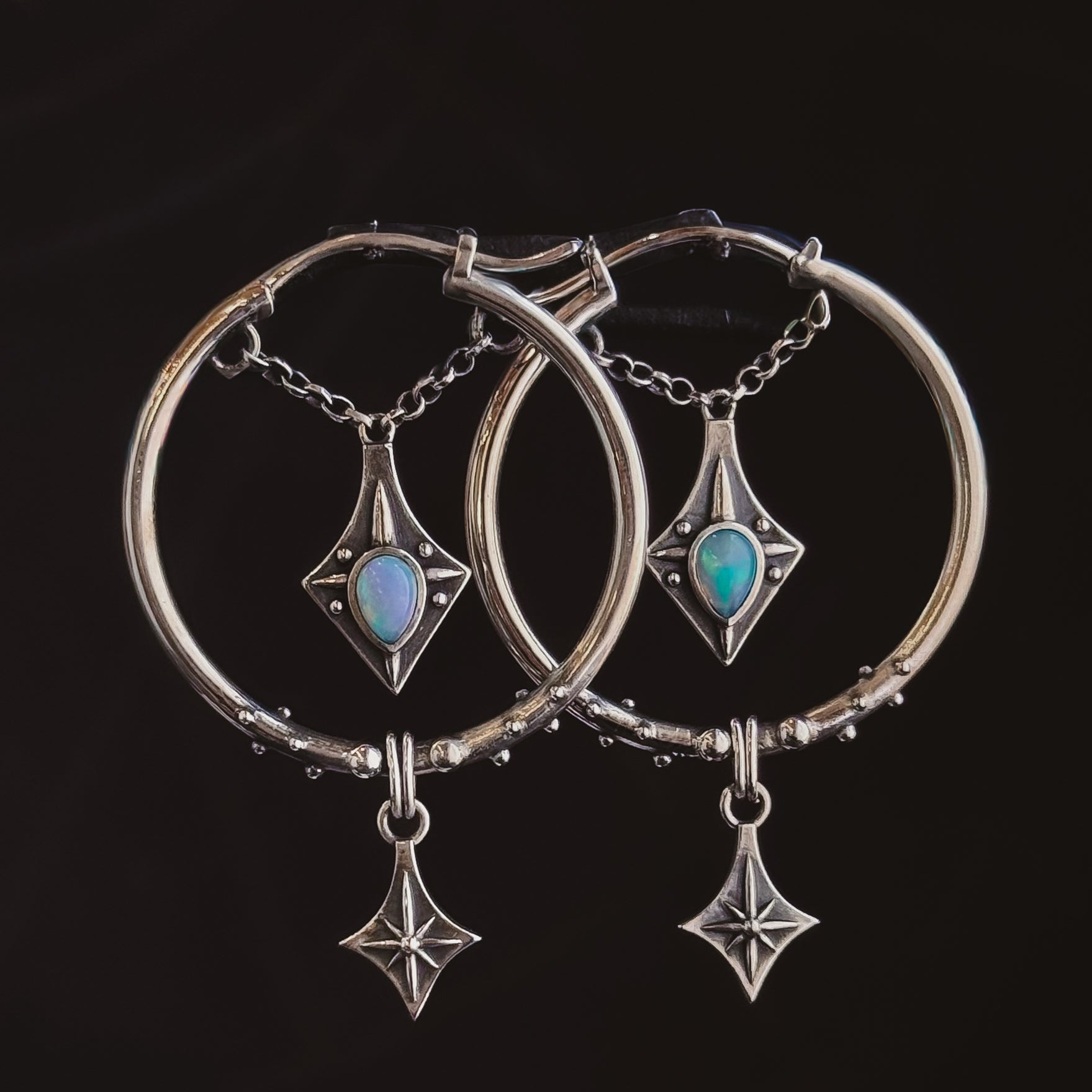

A talisman is an object made or charged to carry a specific intention: to draw something toward you, to remind you who you are, to hold a purpose you chose. An amulet is an object worn to protect, to keep something away. The two words get used interchangeably, including by us, and the overlap is real, but the difference matters when you are deciding what to wear and why. Here is what each one means, where they come from, and how I think about every piece that leaves this studio.
Amulet: the thing that keeps it away
An amulet protects. The Latin word amuletum shows up in Pliny the Elder's writing for objects worn against harm, and the idea is far older than the word. An amulet works by warding: it stands between you and the thing you do not want, whether that is the evil eye, bad luck or a bad night. You do not have to do anything with an amulet except wear it. Its job is passive and constant, like a lock on a door.
The classic amulets are the ones you already know: the eye, the hand, the horn, the cross, the black stone. Across cultures the protective object tends toward the same handful of ideas. Something that watches. Something that blocks. Something dark enough to absorb.
Talisman: the thing that carries intention
A talisman is charged. The word travels into English from the Arabic tilsam, which came from the Greek telesma, a thing completed or consecrated: a rite performed on an object. That origin is the whole definition. A talisman is an object that has had something done to it, by its maker or by its wearer, to hold a purpose. Where an amulet keeps away, a talisman draws toward: courage, clarity, love, a particular kind of strength. It is active. It expects something of you.
The historical talisman was often made at a chosen moment. Renaissance magicians made them under particular planetary hours: a talisman for Venus on Venus's day, in Venus's hour, in Venus's metal and stone. You do not need an astrologer to make one now. The intention is the rite. A ring you put on while saying, out loud, what it is for, is a talisman from that moment.
Both words have a long history. Egyptians wore and were buried with scarabs and the eye of Horus for protection. Freeborn Roman children wore a bulla, a small locket-like amulet, until they came of age. Medieval Europe wore saints' medals and engraved gems, the Renaissance drew up its planetary talismans, and folk traditions everywhere kept the hand, the eye and the iron nail over the door. People have always wanted to wear a decision. The forms change. The need does not.
Which one you need
Ask yourself which job needs doing. If you are walking into a season that is pushing on you (grief, a hard workplace, a move, the dark half of the year), you want an amulet: black onyx, a shield, something that holds the line while you do nothing but keep going. If you are stepping toward something (a new chapter, a commitment, a version of yourself you are ready to be), you want a talisman: a stone you have charged with the thing, worn where you will see it.
A lot of the people who write to us want both at once, and that is not cheating. A shield ring with a stone you have spoken an intention into is an amulet on the outside and a talisman at the center. That is, honestly, the design brief for most of what we make. Our older guide to protection jewelry and its stones covers the amulet side in depth.
Why we make them
I have been making jewelry for fifteen years, and I stopped thinking of it as decoration a long time ago. Every piece here begins with a concept rooted in archetype, myth or an energetic question. The stone is chosen first. The metal is built around it. It is carved in wax, lost wax cast in small batches, hand set and hand finished by one of two metalsmiths, and most of it is made to order, cast fresh when you ask for it. There is no production line, and that is on purpose. A talisman made by the thousand is a charm. One made for a person is something else.
What my customers tell me is that they wear these pieces as armor, as ritual and as declaration, not as decoration. "Remember my strength" is the phrase I hear most, and that is a talisman's job description. The Serpent Queen Necklace is the clearest example on the bench: the ouroboros, the serpent eating its own tail, around a natural labradorite. Worn without a thought, it is a protective symbol, an amulet of the cycle. Worn after you have decided what in your life is ending so that something else can start, it is a talisman, and the same piece of silver has become a different object. The Ritual Dagger Necklace works the same way: a hand-carved blade in the tradition of the athame, the ceremonial knife used to cast the circle and set boundaries. On its own it is a boundary. With a cord named and cut, it is a decision.
Browse the core collection for the pieces we come back to most.
How to charge a piece as a talisman
You do not need a planetary hour. You need a quiet minute and a sentence.
- Cleanse the piece first, so it is not carrying the shop, the mail or the last person who held it. Moonlight, smoke, sound or breath all work.
- Hold it. Say what it is for, in one specific sentence, out loud. Not "protection" but "I keep my ground in that meeting." Not "love" but "I let people be kind to me."
- Put it on. From then on, every time you notice it, the sentence comes back. That is the whole mechanism, and it is older than any of us.
- Charge it again at the new moon, or whenever the sentence changes. A talisman is allowed to grow up with you.
Questions we get about talismans
What is the difference between a talisman and an amulet? An amulet protects: it is worn to keep harm away and works passively, just by being on you. A talisman carries an intention: it is made or charged to draw something toward you and asks you to take part. In everyday speech the words overlap, and many pieces, including most of ours, do both jobs at once.
Can any piece of jewelry be a talisman? Yes, if you charge it. The word's root is a rite performed on an object, and the rite can be as simple as holding a ring and saying what it is for. Pieces built around a stone and a symbol give the intention more to hold on to, which is why we design that way, but the act is yours.
What makes a good talisman stone? One whose traditional meaning matches your intention, and one you will actually wear. Clear quartz is the blank one, worn to hold whatever you give it. Labradorite is worn for transformation, onyx for protection, amethyst for intuition, garnet for staying power. Pick for the sentence you wrote, not for the color.
A talisman is a decision you can wear. Make it out loud, put it on, and let it do its one job, which is reminding you.
From the studio
Four pieces that were built as talismans from the first sketch.

- Serpent Queen Necklace: the ouroboros around a natural labradorite, sterling silver
- Ritual Dagger Necklace: a hand-carved blade in the tradition of the athame, sterling silver
- Maiden Hex Necklace: a talisman for new beginnings, amethyst in sterling silver
- Nimue Cuff Bracelet: a talisman of power worn on the wrist, quartz in sterling silver

