The ouroboros is a serpent eating its own tail, drawn as a closed circle. It means the cycle: the end feeding the beginning, death turning into birth, a thing that renews itself by consuming itself. It is one of the oldest symbols humans have drawn and the one I have spent the most time with at the bench, because once you start seeing cycles you cannot stop, and the serpent is the cleanest way anyone has ever found to draw one.
Where the serpent comes from
The image is Egyptian before it is anything else. The earliest ouroboros anyone has found is painted on a funerary text sealed inside Tutankhamun's tomb: a serpent coiled around the head and the feet of a great figure. The Egyptians were not sentimental about it. The serpent was read as the boundary of the ordered world, the thing that kept chaos out and the sun coming back every morning.
The name is Greek, from oura (tail) and boros (devouring), and the Greeks took the image into philosophy. The alchemists of Greek-speaking Egypt drew it with the words hen to pan inside the circle: the all is one. From there it ran through a thousand years of alchemy as the sign of the work itself, the substance that has to be broken down to be made whole.
The Norse had their own version. Jormungandr, the Midgard Serpent, lies in the ocean around the world with its tail in its mouth, and the day it lets go is the day the world ends. Same serpent, colder water.
Two things are modern and worth flagging as modern. The idea that the ouroboros is a symbol of the psyche, the self that takes in its own dark material and is made whole by it, comes from Jung in the twentieth century. And the story about the chemist who worked out the ring shape of benzene after dreaming of a snake biting its own tail is a story he told himself, decades after the fact. I believe him anyway.
What it means when you wear it
Worn on the body, the ouroboros is a talisman of the cycle. People reach for it at the turn of something: the end of a relationship, a move, the year after a loss, the first clean year, the decision to start over at an age when you were told you were done starting. It says that the ending is a turn, not a wall. The serpent is not dying. It is feeding.
It is also the symbol of the shed skin. A snake does not grow by adding to itself; it grows by leaving the old self behind in one piece, on the ground, where anyone can see it. That is a hard thing to do and a necessary one, and the ouroboros is a reminder that you have done it before and will do it again.
Traditionally it is also worn for wholeness and protection, the closed circle as a boundary with nothing outside it that can get in. That is the Egyptian meaning and it has never gone away.
Why it belongs to Scorpio season
Scorpio is the eighth sign, and eight on its side is the loop with no end. The sign is ruled by Pluto, the planet of death and rebirth, and its animals are three: the scorpion, the serpent and the phoenix, each one a creature that survives by ending something. We wrote about the season and the stones we work through it in Scorpio Season 2026, and the serpent sits at the center of it.
Tomorrow is Samhain, October 31, the night the old calendars kept as the turn of the year. If you are going to put on an ouroboros for the first time, this is the week. The veil is thin, the year is turning, and the serpent is already in its circle.
In the studio: the Serpent Queen
Every piece in this studio starts with a stone, and the Serpent Queen started with labradorite. I wanted a stone that did what the symbol does: looks like one thing and turns out to be another. Labradorite is gray until you move it, and then the blue and gold flash comes up from under the surface. The serpent is built around that stone, head to tail, carved in wax so the scales read, cast in sterling silver by the lost wax method, then oxidized so the dark sits in the scales and the high points wear bright.
It is made to order, like most of our pieces, so it is cast fresh for you, and it takes one to three weeks. People tell us it is even more beautiful in person, and I think that is the flash doing its work. Browse the labradorite collection to see the rest of what we set that stone into.
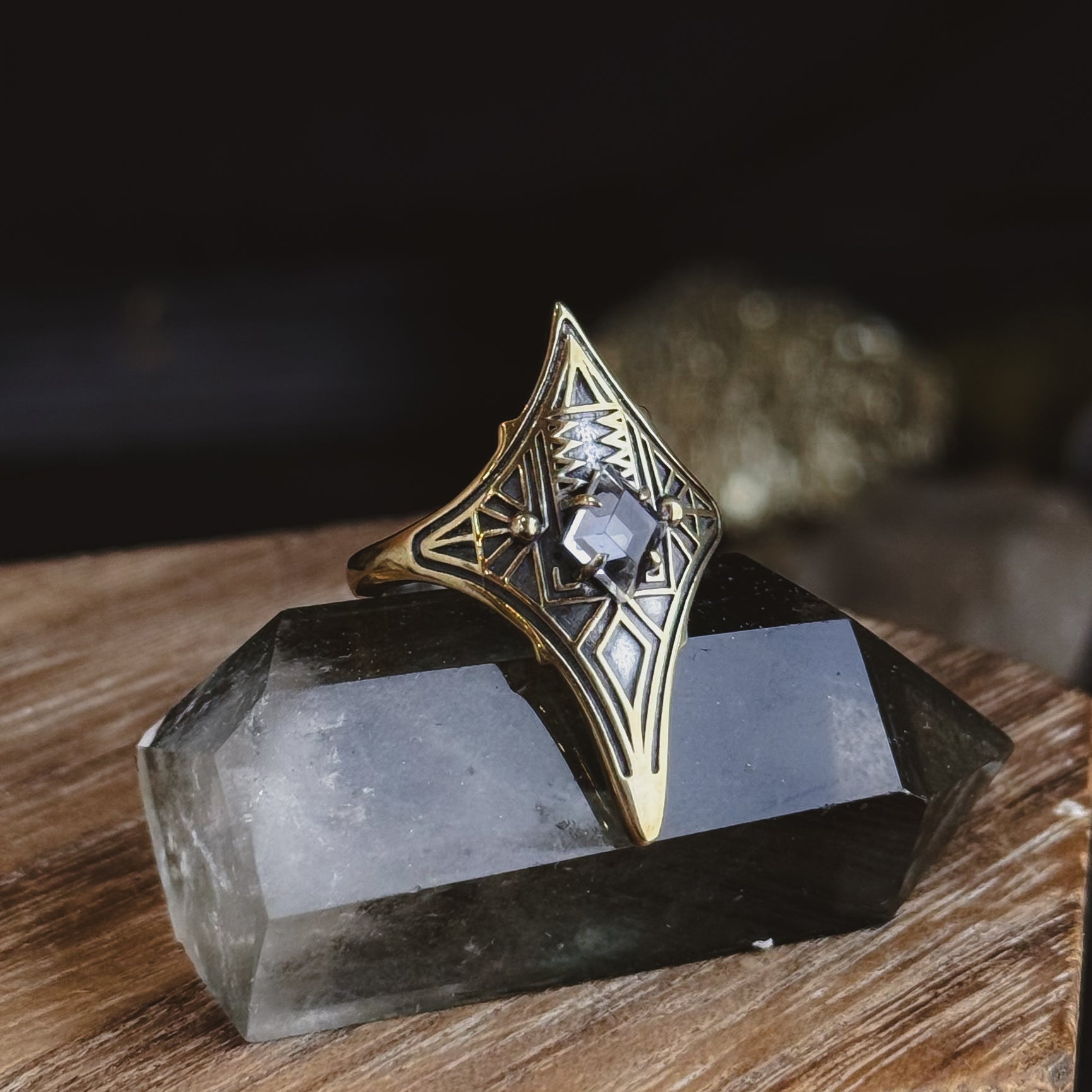
The serpent turns up elsewhere when a drop calls for it. The Serpent Amplifier Ring from our Ostara one-of-a-kind collection, carved once and cast once, is a serpent holding a quartz the way the Serpent Queen holds her labradorite.
How to read an ouroboros on a piece
Not every serpent circle is the same serpent. A few things to look at:
- Is the circle closed? The true ouroboros has its tail in its mouth. A serpent coiled with the tail loose is a different symbol, closer to the guardian snake than to the cycle.
- One serpent or two? Alchemical drawings sometimes show two serpents, each eating the other's tail: opposites feeding each other, the balance held by tension rather than by rest.
- Snake or dragon? Medieval versions often grow wings and feet. The meaning does not change; the dragon is the serpent with its ambitions showing.
- What is inside the circle? Ours holds a stone. Historically the circle held text, a figure, or nothing at all. What you put at the center is the thing the cycle is protecting.
Questions we get about the ouroboros
Is the ouroboros a good or a bad symbol? Neither, which is the point of it. It holds death and birth in the same body and refuses to pick one. Across Egypt, Greece, alchemy and the North it has been a symbol of protection, eternity and renewal, never of harm. If a symbol that admits endings exist feels dark to you, this one will. We find that honest rather than dark.
What is the difference between the ouroboros and the infinity symbol? The infinity sign is a mathematical figure, a sideways eight, and it means endlessness without a story. The ouroboros is a creature. It eats, it sheds, it keeps itself alive by its own effort. Infinity is a fact. The ouroboros is a practice.
Can I wear an ouroboros necklace every day? Yes. Ours is cast in sterling silver and built to be worn, and the symbol is one people tend to keep on rather than take off. If yours carries labradorite, take it off before water and the gym, wipe it with a soft cloth, and turn it toward the light now and then so you remember what is in there.
The serpent has been eating its tail since before anyone wrote down why. Put it on and let it keep going.
From the studio
The serpent shows up in this studio whenever a piece is about a cycle, and these are the ones that carry it.

- Serpent Queen Necklace: the ouroboros in sterling silver around a natural labradorite
- Serpent Amplifier Ring: a one-of-a-kind serpent ring from the Ostara drop, set with quartz
- Snake Trails Ring: a one-of-a-kind ring from the Ostara drop, set with amber