

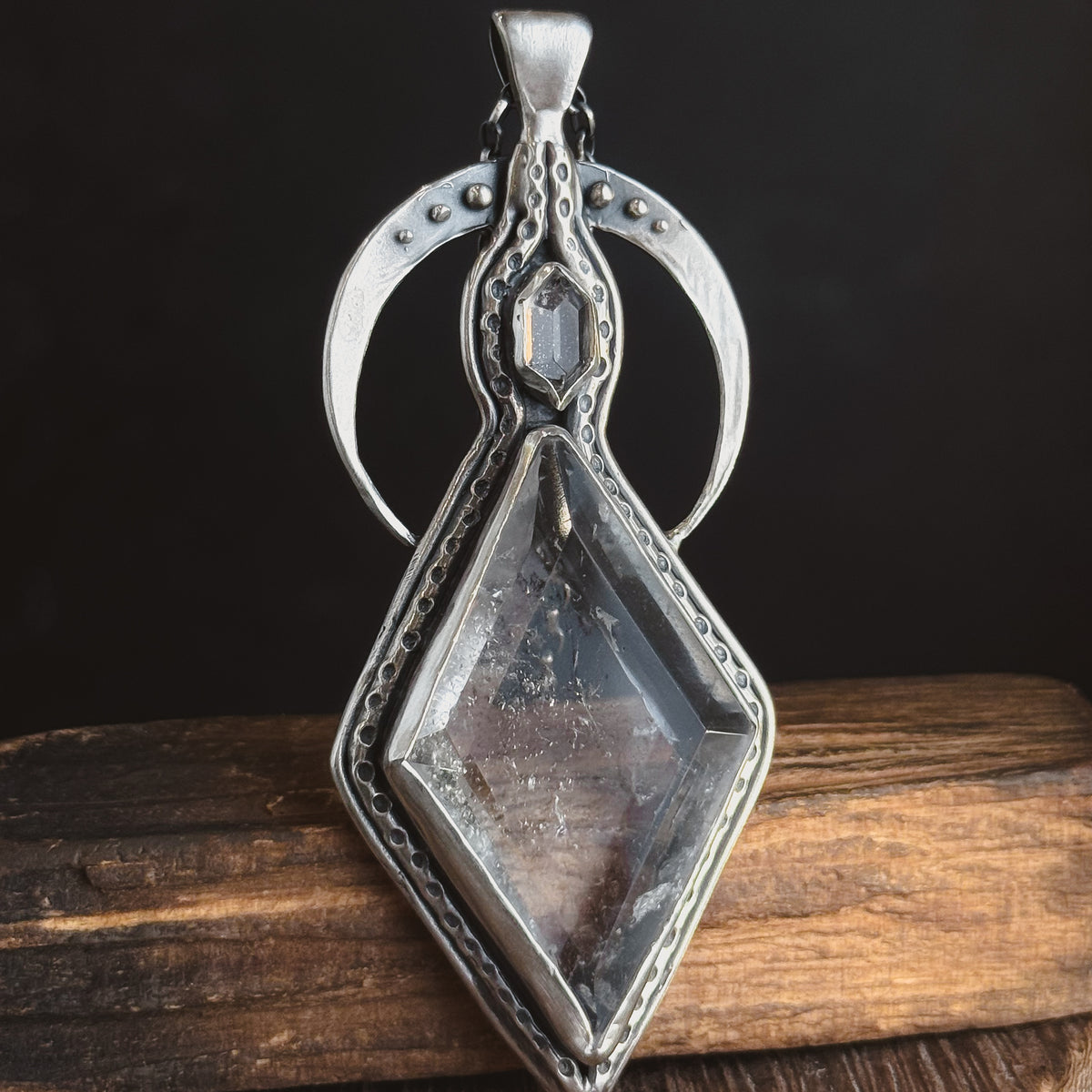
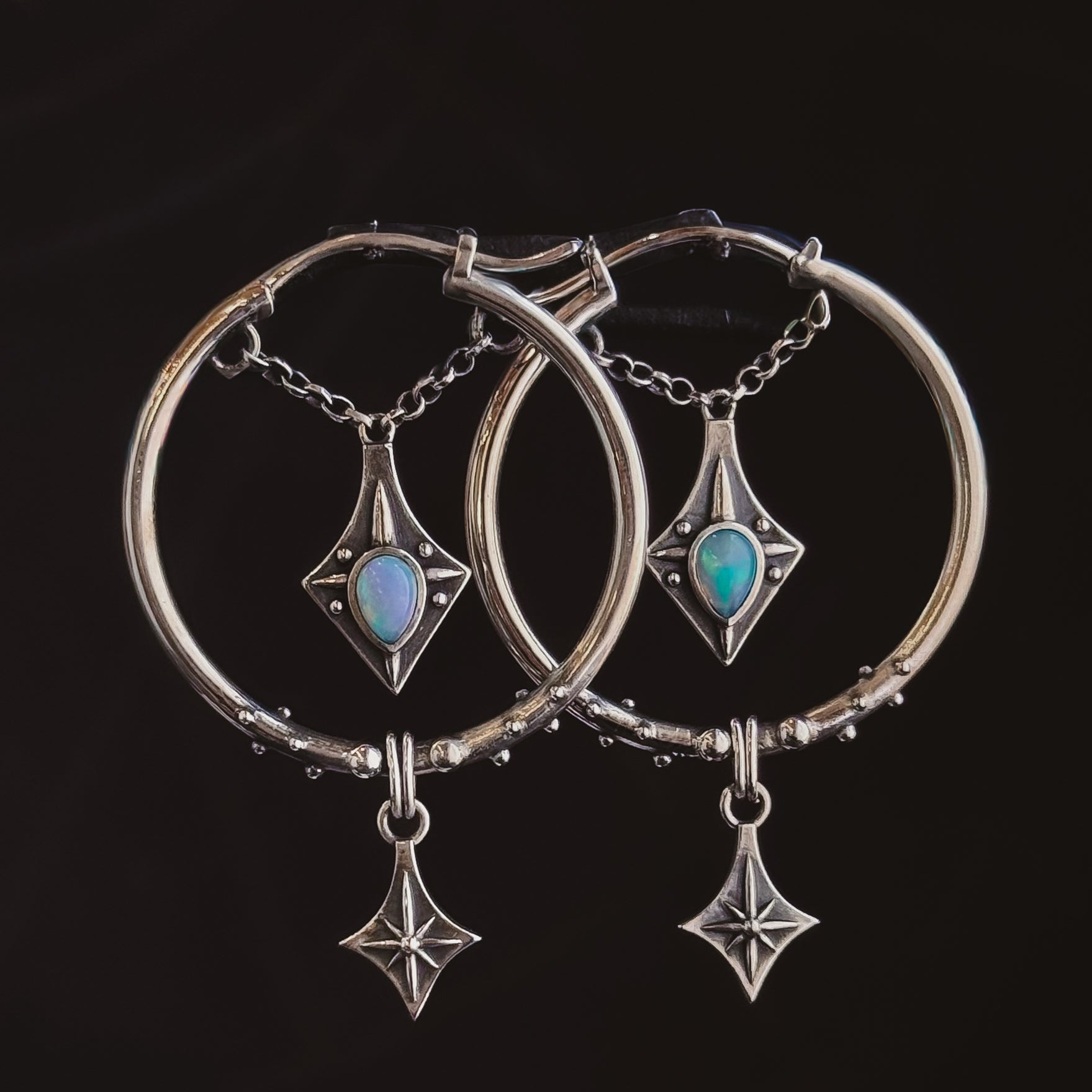

Labradorite is a feldspar, gray and quiet until it moves, and then it throws blue and gold light from somewhere under the surface. By tradition it is the stone of transformation and intuition: worn for seeing what is hidden, in a situation and in yourself, and for protection while you change. Here is what the flash actually is, where the stone came from, what we reach for it for, and how to keep it alive on your hand.
What the flash is
The flash has a name, labradorescence, and it was named after the stone rather than the other way around. Labradorite is a plagioclase feldspar, and inside it are layers so thin that light does not pass straight through them. It scatters between the layers, and what comes back is color: blue most often, then gold and green, and every so often a stone that flashes orange or violet.
Two things follow from that, and both matter when you wear it. First, the flash is directional. It lives at a particular angle, so a labradorite is dark from one side and lit from another, and you have to turn it to find the light. Second, no two stones carry the same flash. The layers formed differently in every one, so the stone you hold is the only stone that does exactly that.
A good labradorite is not the one with the most color. It is the one with the color in the right place, where it wakes up when your hand is at rest.
Where it was found, and the story told about it
The stone is named for Labrador, on the northeast coast of Canada, where it was found in the 1770s and sent back across the Atlantic. The gray rock of that coast had been throwing blue light at people for a very long time before anyone wrote a report about it.
There is a story told about it: that the northern lights were once caught in the rocks along that shore, that a hunter struck them loose with his spear, and that the light he could not shake out is what still flashes in the stone. I cannot tell you how old that story is or who first told it, and I have read enough versions to suspect the gem trade polished it. I like it anyway. It is the right story for a stone that keeps its light inside.
What labradorite is worn for
Labradorite is the stone of the mystic and the shapeshifter. Traditionally it is worn for intuition, for seeing beneath the surface of a person or a situation, and for protection during transformation, the stretch where you are no longer who you were and not yet who you are becoming. We reach for it when the question is not what to do but what is really going on.
It is also, in practice, a stone for people who do their work quietly. The gray surface is not a disguise; it is a door. The flash is for whoever bothers to look. That is why it has been the stone of the seer in so many traditions: not because it shouts, but because it does not.
If protection is the main thing you need from a stone, we have a guide to the protective stones and how we build with them in Anchored in Power. Labradorite sits in it beside onyx, and the two together are the pair we wear through Scorpio season, the one we wrote about in Scorpio Season 2026.
Why I build with it
Every piece here begins with the stone, and labradorite is the one I choose when the piece is about what is hidden. I choose each one for where its flash lives, and I want that flash facing up when the hand or the chest is still, so the metal is built around it. The Serpent Queen Necklace holds a labradorite inside the ouroboros because the serpent is about what comes back around, and the stone is about what you did not see the first time. The Moon Maiden Necklace sets it in sterling silver as a talisman for awakening, for the woman stepping into her intuitive power.
We oxidize our silver, and labradorite is the stone that rewards it most. Dark metal around a gray stone sounds like nothing. Then the blue comes up, and the dark is the reason you see it.
Browse the labradorite collection for everything we set it in, sterling silver and brass, made to order and one of a kind.
How to wear it and how to care for it
Wear it every day if you want to; it is a stone that likes to be worn, and the more it moves, the more it flashes. Two cautions. Labradorite is softer than quartz, and it has cleavage planes, which means a hard knock on an edge can chip it where a quartz would shrug. Take it off for the gym, the garden and anything involving a hammer. And keep it out of long soaks: a quick rinse in lukewarm water is fine, a bath is not, and an ultrasonic cleaner never.
For the flash, the fix is almost always a cloth. Labradorite goes flat when there is residue on the surface, lotion or soap or a day's worth of hands, and a dry microfiber cloth brings it straight back. If it still looks dull, it does not need cleaning. It needs light. Turn it.
Questions we get about labradorite
What is labradorite good for? By tradition, intuition, transformation and protection during change. People wear it for the stretch between one life and the next, for work that asks them to read beneath the surface, and as a reminder that what shows on the outside is not all that is there. It is the stone we recommend most for anyone in the middle of becoming something.
Is labradorite the same as moonstone? No, though they are cousins. Both are feldspars, and both glow from inside, but the effects are different: moonstone's soft floating light is called adularescence, and labradorite's sharper colored flash is labradorescence. Moonstone reads as a glow. Labradorite reads as a flash. We set both and reach for them for different reasons.
Can I wear a labradorite ring every day? Yes, with care. Rings take more knocks than pendants, and labradorite can chip at an edge, so take it off for heavy hands-on work and before water. Wipe it with a soft cloth at the end of the day, and it will keep flashing for as long as you keep turning it.
Labradorite does not show you everything at once, and neither should you. Wear it, turn it, and keep the rest for the ones who look.
From the studio
Labradorite is the stone I reach for when a piece is about what is hidden, and these are the ones that carry it.

- Moon Maiden Necklace: labradorite in sterling silver, a talisman for awakening
- Serpent Queen Necklace: the ouroboros around a natural labradorite in sterling silver
- Sefira Choker Necklace: two labradorites in a sterling silver choker from the Astral collection
- Moons Ring: a one-of-a-kind labradorite ring in brass, size 7

