Smoky quartz is clear quartz that was darkened by natural irradiation inside the earth, and it is the stone we reach for when something needs to be set down slowly and on purpose. In practice it is worn for grounding and release. It is also the stone I hand to people who pick up black onyx, hold it for a second, and put it back because it feels like too much. Here is what smoky quartz is, where its names come from, what it is worn for, and why the Draco Ring exists.
What smoky quartz actually is
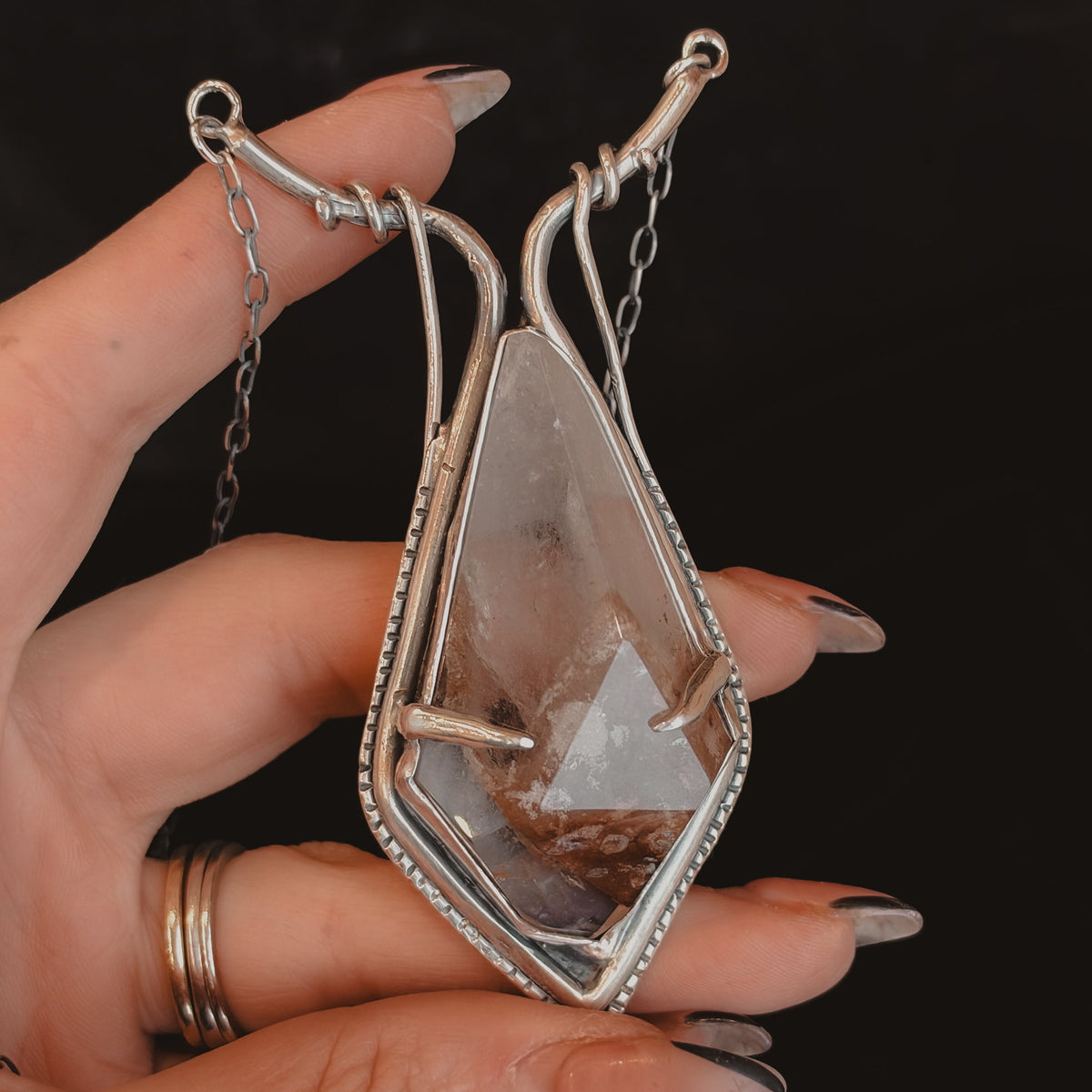
Smoky quartz is quartz: the same silicon dioxide as the clear points and spheres in so many of our pieces, with the same hardness (a 7 on the Mohs scale) and the same habit of growing in six-sided crystals. The difference is the color, and the color is a scar. Natural radiation in the surrounding rock, acting over a very long time, darkens the crystal from the inside, which is exactly as metal as it sounds. The result runs from the color of weak tea to a brown so deep it reads black until you hold it to a window.
That last part matters. Smoky quartz is transparent or translucent. Light goes into it. Even the darkest stone has a glow at its edges when the sun catches it, and a faceted smoky quartz throws light around the way a faceted clear quartz does, only warmer. Onyx does not do this. Onyx is a wall. Smoky quartz is a window with the curtains half drawn.
In Scotland the stone has its own name, cairngorm, after the Cairngorm mountains where it was dug, and the Scots have been setting it in their Highland jewelry for a long time. I like that history because it is a working history. Cairngorm was not a stone for a glass case. It went on a brooch or a knife handle and got worn.
What smoky quartz is worn for
The traditions that assign stones to the body put smoky quartz at the root: the base of the spine, the feet, the part of you that stays put when the rest of you wants to leave. It is a grounding stone, and the distinction we draw in the studio is that it grounds by moving things through rather than by holding them. Onyx absorbs and holds. Smoky quartz takes what is heavy and lets it drain out through the floor.
That is why it is the stone of release. It is worn for letting go, for grief that has been sitting too long, for the end of something you already know is over. It is the stone we recommend for shadow work when onyx feels like armor you are not ready to put on. It is also, quietly, a stone for people who live too much in their heads. If clear quartz is the amplifier, smoky quartz is the volume knob turned down to where you can think.
We wear it through the dark half of the year, from Samhain to the solstice, and it is one of the four stones in our Scorpio season post for that reason: it is the stone for the second half of a transformation, after the dramatic part, when you have to actually live in the new shape.
Smoky quartz or black onyx?
People ask us this more than any other comparison, so here is the honest version.
Black onyx is a banded chalcedony, which is quartz too, but microcrystalline: made of crystals too small to see, packed tight, so the stone is opaque and takes a flat, mirror-black polish. Most black onyx sold commercially has been dyed to get that even black, and that is standard practice, not a trick. Onyx is worn for protection and boundaries. It is the stone you put between yourself and a room.
Smoky quartz is a single crystal you can see into. It is worn for grounding and release. It is the stone you put between yourself and your own spiral.
If you are walking into a hard conversation, wear onyx. If you are walking out of one and need to put it down, wear smoky quartz. If you are not sure which you are, smoky quartz is the gentler mistake. Plenty of people end up with both, and the pairing makes sense: one holds the line, the other clears the ground behind it.
In the studio: why the Draco Ring is smoky quartz
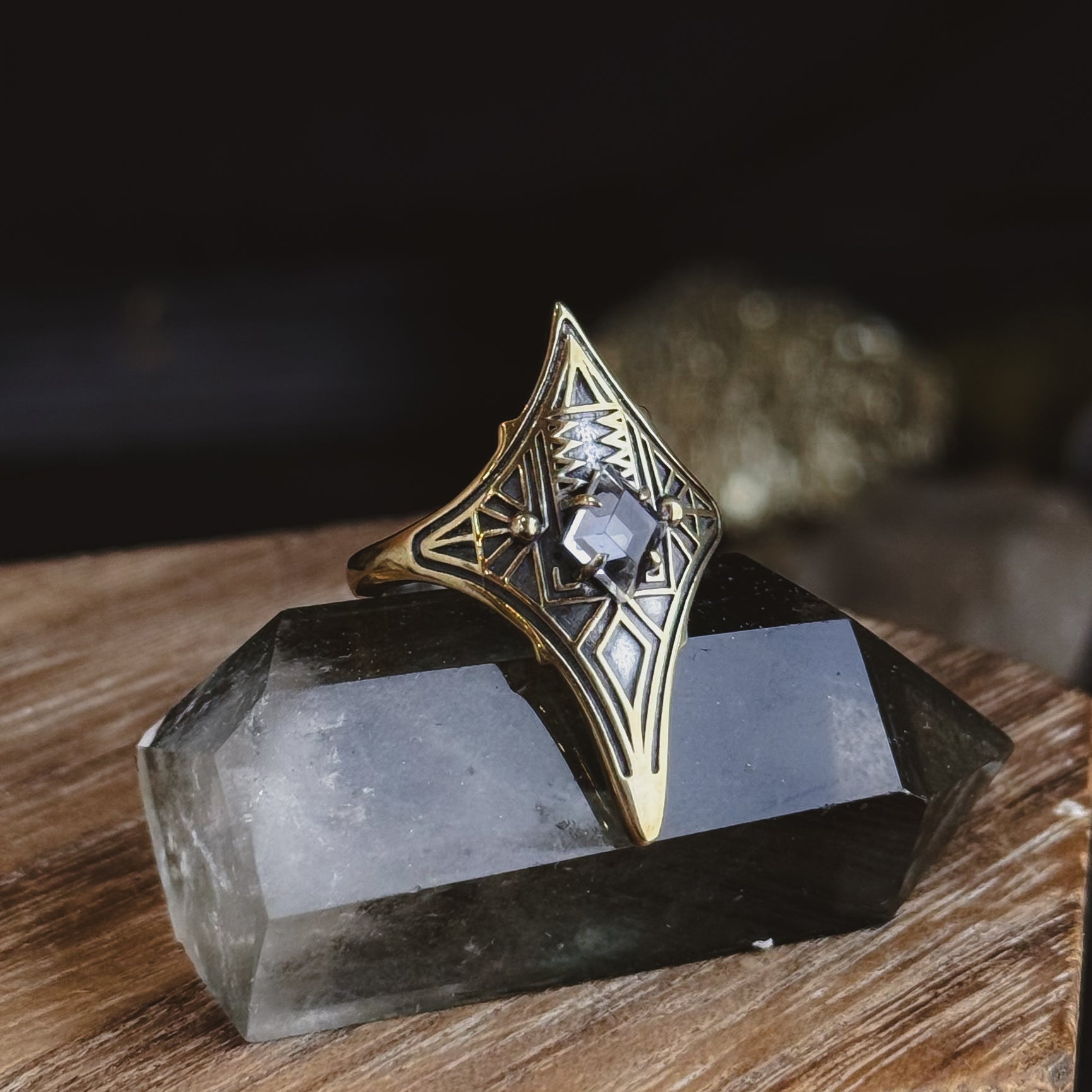
When I designed the Draco Ring I wanted an eye. Draco is the dragon constellation, the long serpent that winds between the Big and Little Dippers, and a dragon's gaze is the whole point of a dragon: watchful, steady, not easily moved. I needed a stone that could hold a stare without being cold, and a flat black stone would have been cold. A smoky quartz cabochon has depth. Light goes in and does not come straight back out. Set in sterling silver, in a geometric bezel with textured metalwork around it like scales, the stone looks like it is looking back. The ring is hand carved in wax and lost wax cast, like everything we make, and the smoky quartz is hand set at the very end.
Faceted smoky quartz turns up in our one-of-a-kind work too. The Double Visions Cuff pairs a faceted smoky quartz with a labradorite in brass, which is the two sides of the dark half of the year on one wrist: the flash and the ground. I reach for smoky quartz whenever a design needs weight without heaviness. Browse the quartz collection for the rest of the smoky and clear quartz pieces.
How to care for smoky quartz
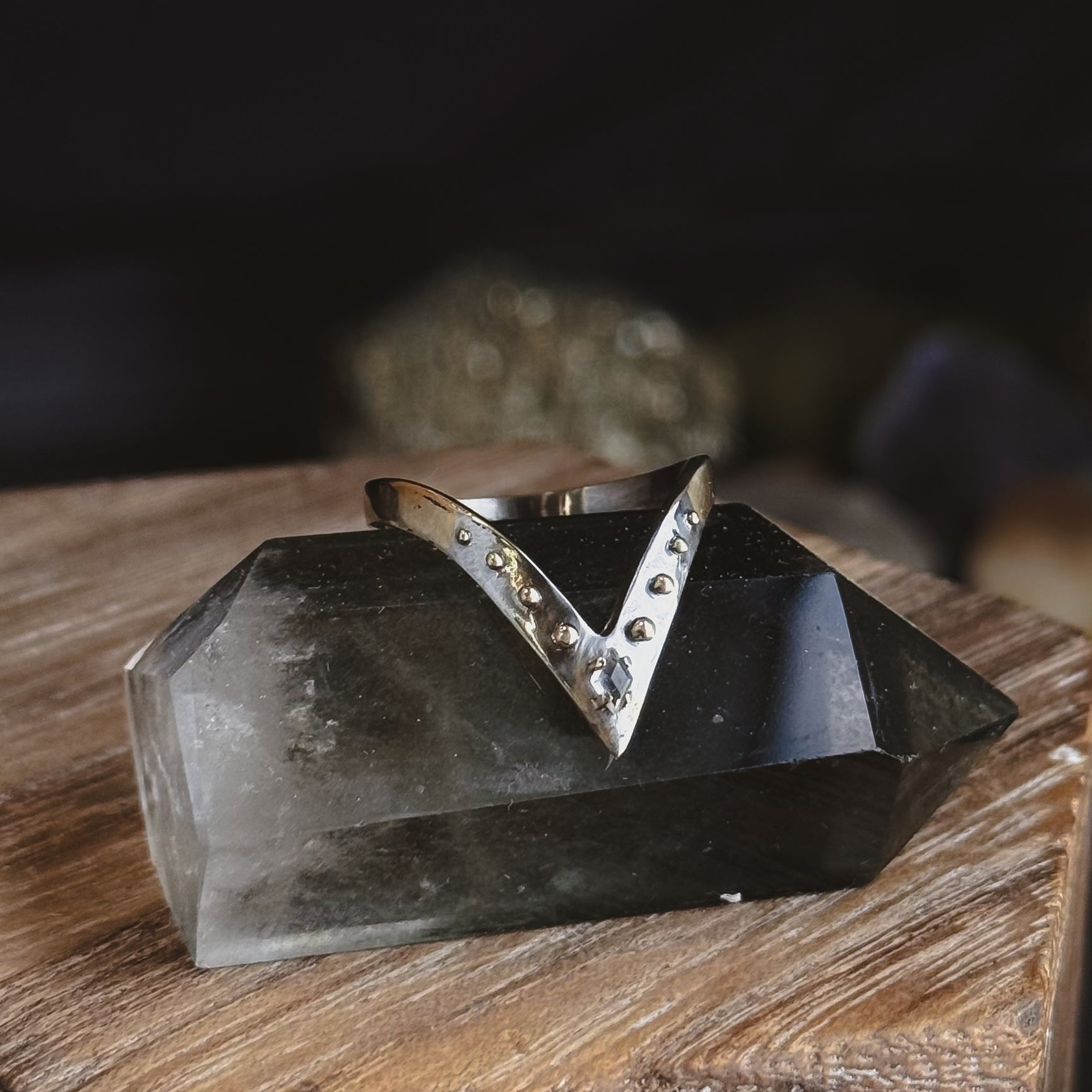
Quartz is hard enough for daily wear, so a smoky quartz ring can live on your hand. Take it off for anything that involves a hammer or a bucket of water, store it apart from softer stones so it does not scratch them, and clean it with warm water, a drop of mild soap and a soft brush. Skip the silver dips: they strip the oxidized finish from the metal around the stone, and that darkness in the recesses is part of the design. Our stone by stone cleaning guide covers the rest.
Questions we get about smoky quartz
What is smoky quartz good for? In practice, grounding and release. It is the stone worn for letting go of what is finished, for staying in your body when your mind is loud, and for the slow part of a transformation. Traditionally it is tied to the root, the base of the spine, which is why so many people describe it as the stone that makes them feel like their feet are on the floor.
Is smoky quartz the same as black onyx? No. Both are quartz in the broad sense, but black onyx is a microcrystalline chalcedony, opaque and usually dyed to an even black, while smoky quartz is a single transparent-to-translucent crystal darkened by natural irradiation. Onyx is worn for protection and boundaries. Smoky quartz is worn for grounding and release. One holds; the other lets go.
Can I wear a smoky quartz ring every day? Yes. Quartz sits at 7 on the Mohs scale, so it stands up to daily wear better than softer stones such as moonstone. Take it off for heavy work and water, keep it away from silver dip, and it will outlast most of what is in your jewelry box.
The dark stone does not have to be the heavy one. Pick the window over the wall, and let it drain.
From the studio
These are the smoky quartz pieces in the studio right now, the grounding stone set the way I like to set it: deep, textured and looking back at you.

- Draco Ring: a smoky quartz cabochon as the dragon's eye, in sterling silver
- Double Visions Cuff (one): one-of-a-kind brass cuff with labradorite and faceted smoky quartz
- Crystal Chain Belt: one-of-a-kind chain belt, faceted smoky quartz in sterling silver
- Double Visions Chest Shield Necklace: one-of-a-kind brass chest shield with faceted smoky and clear quartz